
wcg 2019

West Coast Consulting

How AI Agents Turn Long Forms Into Short Conversations

An AI agent can consistently get more people through a form, while producing cleaner data.

▶ Watch the two-minute demo on YouTube to see an agent take a volunteer from the first question to a saved record.
 

The problem with long forms

A long web form asks for everything at once and explains very little. People stall on fields they don’t understand and guess at date formats. Often they leave halfway through.

The ones who finish can lead to records that need cleanup before anyone can use it. An agent collects the same data one decision at a time, and it checks each answer before it moves on.

A conversation on top, a typed schema underneath

The agent never improvises. Underneath the chat is the same schema the old form used, with field names, types, required flags, picklist values and the rules that link them.

The model has a narrow job. It works out which required field is still empty and asks for it in plain language. When the answer comes back, it maps the words onto the required slot.

A session can pause, resume or branch. Conditional fields stay hidden until an earlier answer makes them relevant. An individual volunteer never sees the questions meant for a group coordinator.

Structured inputs inside the conversation

Pure chat can be a poor fit for some fields. Typing a date of birth, or picking one of eight relationship types, is faster with a control than with a sentence.

So the agent renders small components inside the conversation, such as a pair of name fields or a picklist. Each component is generated from the field’s schema entry. Its value posts back as structured data, so nothing has to be derived from free text.
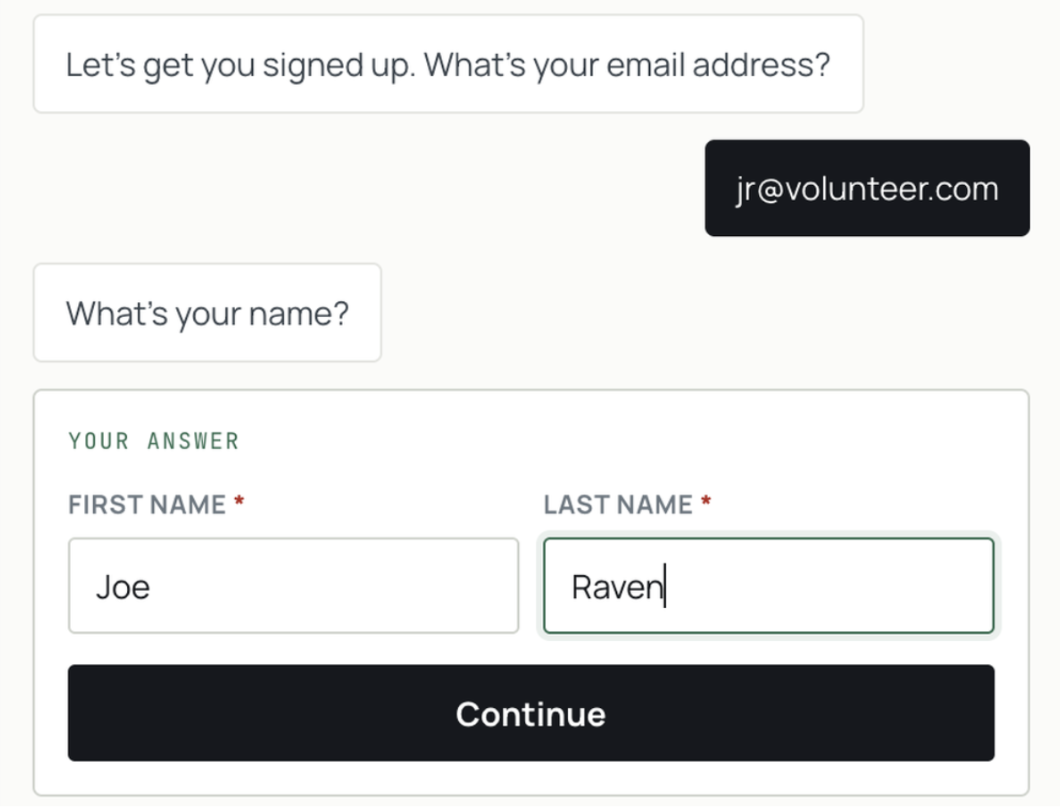
The agent asks one question, then renders the matching required fields inline.

Validation at the moment of entry

Every saved record passes through a deterministic validation tool. The model never decides on its own whether a value is valid. Emails get a format check, phone numbers are normalized to ten digits, and birth dates are tested against a minimum age.

Free text gets normalized as well. “Next Tuesday” becomes a date, and “my wife” maps to the Spouse picklist value.

When a value fails, the tool returns the specific reason and the agent asks again in context. That costs one extra message. On a traditional form the same error shows up as red text after submit, often on a field the person scrolled past minutes ago.

A bulk path for groups

Conversation is the wrong interface for entering forty people. For bulk entry the agent switches to a structured file. It generates a spreadsheet template from the same schema, with required columns marked and dropdowns built from the picklists.
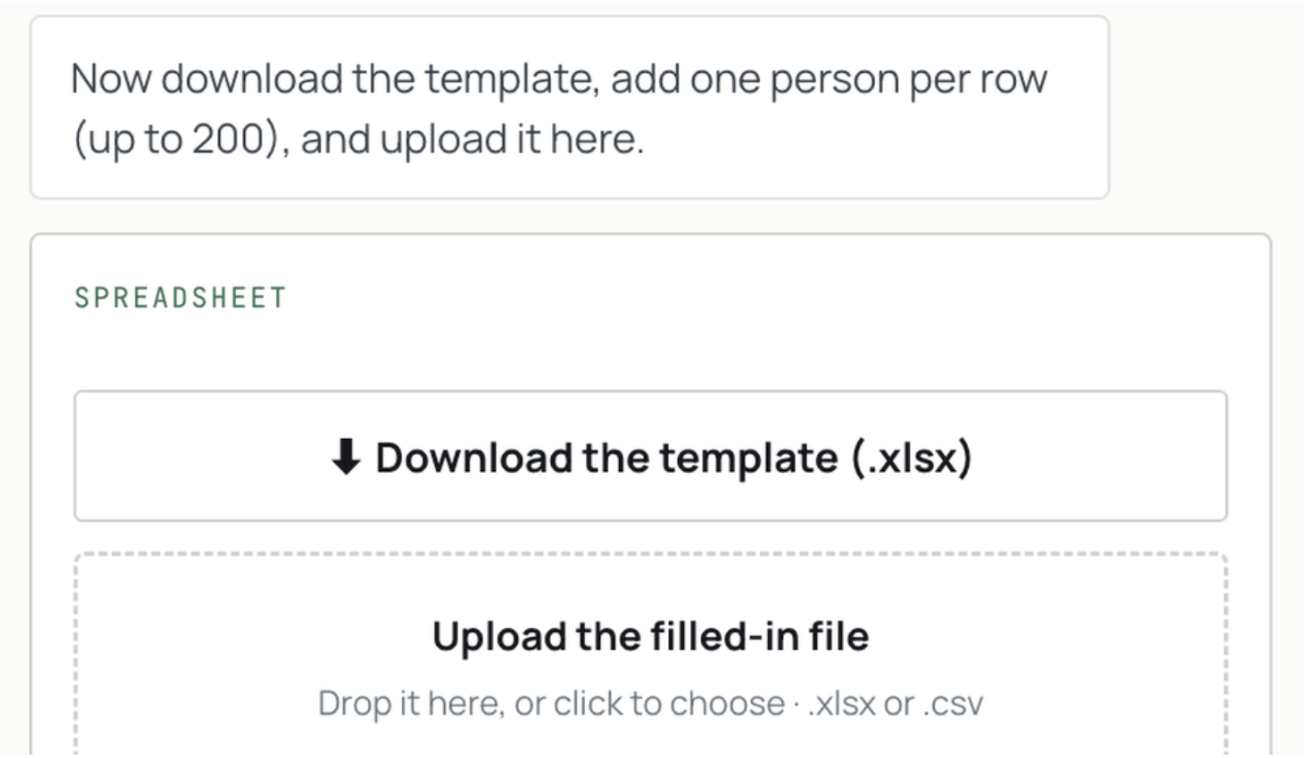
The agent hands group coordinators a schema-built template and an upload target in the same chat.

When the file comes back, each row runs through the validators the chat uses. Rows that pass are staged. Rows that fail come back as a short list with the row number and the reason, so the coordinator can fix three cells and keep the rest.

Because one schema drives both paths, a rule changed once applies to chat and spreadsheet alike.

Confirm before commit

Nothing is written until the volunteer has reviewed the whole record. The agent assembles the staged records into a review card and pairs it with any required consent, such as a waiver checkbox that must be checked before submission.

Once confirmed, the tool writes the record to the system of record in one transaction and returns the new record ID to the conversation. Your staff receives a complete, validated record and can skip the follow-up calls.
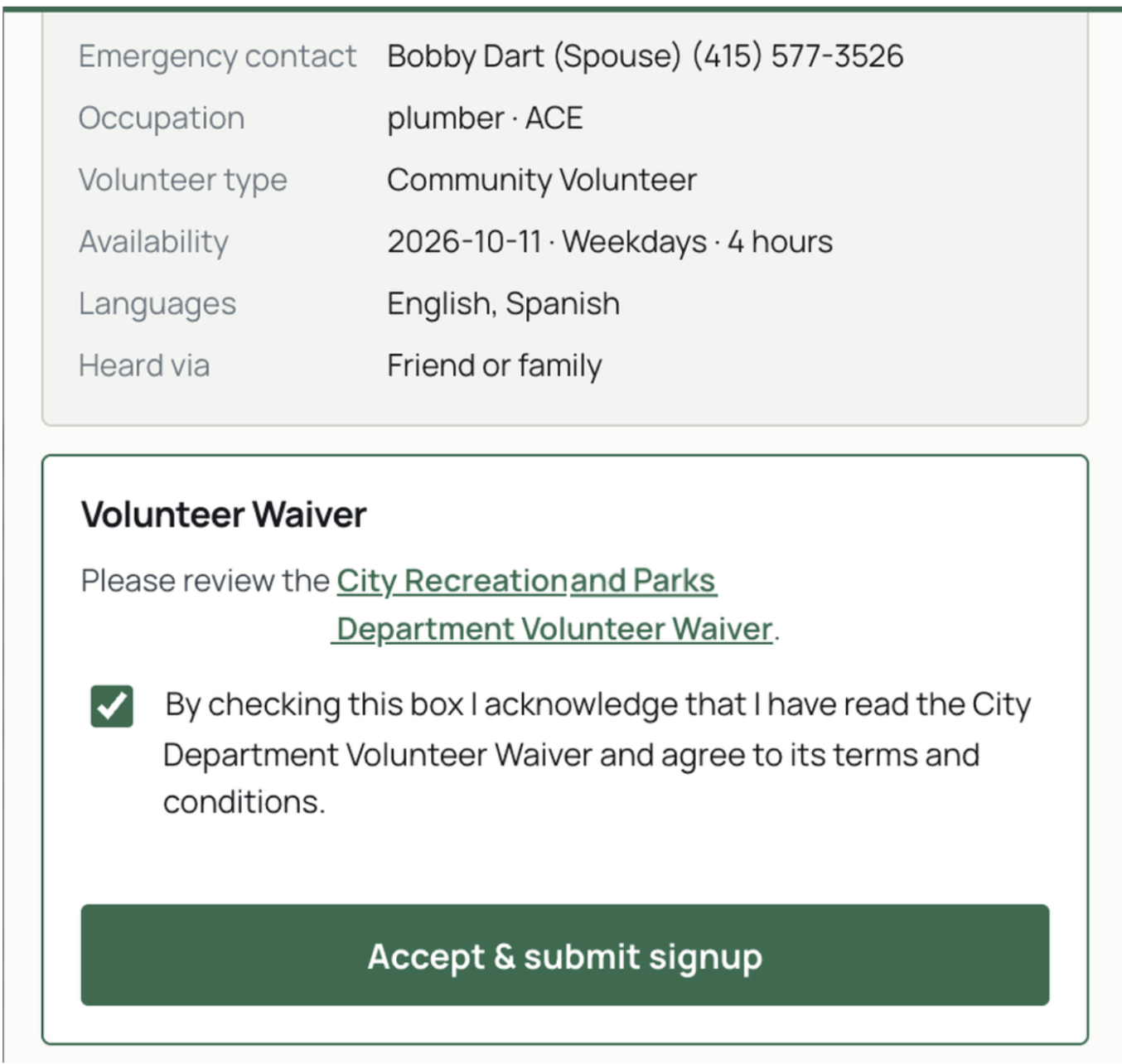
A review card of the staged values, with the waiver consent gating the submit button.

Guardrails that keep the data trustworthy

  • Narrow tools. The model never writes records directly. It calls tools with specific arguments, such as validating a field,  enforcing permissions, or saving a registration.
  • Audit trail. Every tool call is logged with its inputs, so your staff can trace any saved value back to the question that produced it.
  • Data stays home. Personal data lives in the system of record. The conversation keeps only what it needs to finish the session.
  • Clean commits. A double click or a dropped connection never creates a duplicate person.


Easier for Registrants, Better Data for You

Agents make forms better when the model handles language and deterministic code handles the data. That split lets one system serve two audiences at once. Your registrants get a better experience, and your team gets better data.

For registrants. Each step is one question in plain language, so people finish what they start. Help arrives at the field where the question comes up, with no hunting through FAQ pages. A volunteer can stop and come back without losing what they entered. A group coordinator uploads one file for forty people and fixes only the rows that need it.

For your team. Records arrive complete and checked, because every value was validated when it was entered. Staff stop chasing missing phone numbers and reformatting dates. Consent is captured with the record, so every audit has a clean trail. Each registration lands in your system the moment it is confirmed, ready for rosters and follow-up.

For the organization. The same pattern fits any intake you run today, from applications and permits to enrollments and service requests. The agent sits on top of the data model and rules you already have. You keep your system of record and change only the experience in front of it.

A good place to start is the form with the highest drop-off or the most cleanup work behind it. West Coast Consulting Group designs and builds these agents for organizations that use complex intake forms. Call (415) 626-3493 or email info@westcoastconsulting.com to talk with us about yours.
 

▶ See it on YouTube

October 23rd, 2026|Categories: AI|Tags: , , , |

Connect your Salesforce with Claude Enterprise

Your regional sales director wants to know which accounts went quiet last quarter. She asks RevOps. The report arrives four days later, after she has already made the decision. The data was in Salesforce all along. 

We natively Integrate your Salesforce Enterprise Org with Claude Enterprise 

More of our customers are asking why their sales teams cannot use AI to make sense of CRM data as easily as they use it to work through a contract or spreadsheet. Integrating Claude and Salesforce makes it possible to answer questions like these:

  • Which deals should I focus on this week based on close date, recent activity, deal size, and next steps?
  • Draft a personalized follow-up for Jane Doe based on our last meeting and the opportunity record.

Claude Enterprise pulls the relevant details from the account and opportunity records without your rep opening six tabs or waiting on a report request. Where you allow it, Claude can update Salesforce as well, following the permissions and business rules you already have in place.

Your Data and Permissions Still Matter

We handle the connection between Salesforce and Claude. We also work through the decisions that determine whether the integration produces reliable answers for your organization:

  • Which objects and fields should Claude use?
  • How should existing roles and sharing rules carry through?
  • Which records should Claude be allowed to update?
  • Which actions should require human approval?

Claude works with the Salesforce environment you have today. We review your data model so that Claude bases its answers on fields your team trusts. If account hierarchies are outdated or activity records are incomplete, we identify those issues before rollout.

Permissions require the same scrutiny. We review your current access model and tighten it where needed. Before go-live, we confirm what each role can see and what happens when Claude writes to a record.

How We Implement the integration  

We require Claude Enterprise so that access, retention, and user activity remain under your company’s administration. We integrate with Salesforce Enterprise or Unlimited Edition, which include the API access that lets us configure the integration around your permissions and processes. 

We have worked with Salesforce since 2004 and completed more than 650 cloud implementations. We know how the underlying data and access models shape the answers your users get.

We configure the connection around your existing data and access model, then test it against the questions your team actually asks and the actions you want Claude to take. If your org needs additional configuration or workflow design, we show you where and why.

Bring us the questions your sales team keeps asking. We’ll show you how Claude integrates with Salesforce in a 30-minute working session

[Request working session] https://245067415.hs-sites-na2.com/claude-salesforce-working-session

For more information, please contact West Coast Consulting Group at info@westcoastconsulting.com or call 415-626-3493.

NCUCA 2026: Key Takeaways

West Coast Consulting Group was a proud sponsor of NCUCA 2026 in Las Vegas, where we presented CloudCollect, our collections automation application. Here are our key takeaways.

As NCUCA President Art Sookazian noted in his keynote, credit unions are experiencing the highest delinquency rates since 2012. Against that backdrop, one theme came through clearly across sessions, roundtables, and booth conversations: AI is rapidly moving from concept to expectation in collections.

The Shift Away from Reactive Models

The most significant change underway is the move away from traditional, reactive models built around days-past-due thresholds. These models were designed for a manual world and are increasingly seen as too slow. Industry benchmarks suggest that engaging members before accounts reach 30 days past due can improve cure rates by two to three times. The earliest days of delinquency often determine the outcome.

AI is helping operationalize this shift by enabling earlier signals, dynamic prioritization, and more consistent outreach. When engagement happens quickly and consistently, recovery rates are significantly higher. When it doesn’t, accounts roll forward into stages where resolution becomes more complex and costly.

Member Experience Is Core to Collections

Member experience is taking on a more central role in collections strategy. Collections teams understand that how a credit union handles a difficult conversation directly impacts long-term member relationships. Discussions at NCUCA increasingly focused on communicating with members in ways that are respectful, transparent, and aligned with credit union values. Members expect timely, personalized outreach and clear resolution options. AI is becoming a meaningful tool here, helping tailor communication, timing, and channel selection at scale.

Automation Is Becoming Essential to Scale

Operational pressure was another persistent theme. Many collections teams are managing increasing complexity with limited resources. As portfolios grow and compliance requirements expand, manual workflows are becoming harder to sustain.

Across sessions and vendor conversations, a consistent picture emerged: 60 to 80 percent of collections activity remains manual. Collectors often spend half their time on administrative work rather than direct member engagement, toggling between core systems, spreadsheets, and call logs just to understand the state of an account before a conversation even begins.

That said, most organizations are not yet positioned to take advantage of AI. Without structured workflows, centralized data, and consistent processes, AI cannot deliver meaningful value. When those elements are in place, automation can fundamentally change how collections teams operate, freeing up capacity while improving both consistency and outcomes.

Modernizing Around the Core

Underlying many of these challenges is the role of the core system. Most credit unions rely on platforms like Symitar as their system of record, but few see these platforms as sufficient for modern collections operations. Teams describe environments where collectors navigate multiple screens, spreadsheets, and manual notes just to get a complete picture before making a call.

The path forward is not replacing the core. It is building a workflow, automation, and intelligence layer on top of it. This is also where AI capabilities will increasingly live, acting on structured data and orchestrated workflows to give collectors a complete view of the member and the ability to act quickly and consistently.

Looking Ahead

Taken together, these themes point to a meaningful transition for credit unions. The future collections teams are working toward is proactive rather than reactive, operationally efficient, member-centric, and increasingly automated. NCUCA 2026 made clear that the ambition to change is not the constraint. Credit unions understand where collections need to go. The challenge is execution: moving from discussion to implementation, and from incremental improvement to a modern, data-driven operating model.

West Coast Consulting Group is here to help credit unions make that shift. CloudCollect, our collections management solution, provides the structured workflows, centralized member data, and automation layer that modern collections teams need. Whether you are starting that journey or accelerating it, contact us today to let us help you build the foundation required for the AI era.

How West Coast Consulting Group’s app CloudCollect was used to launch Connecticut Paid Leave

The successful administration of Connecticut Paid Leave (CTPL) required more than legislative approval; it depended on robust technological and financial infrastructure capable of managing large-scale contributions, compliance, and collections. As Connecticut rolled out its Paid Leave program, West Coast Consulting Group played a critical role in supporting its operational foundation through the implementation of CloudCollect, an advanced collections and accounts receivable management platform.

The Operational Challenge Behind CT Paid Leave

Connecticut Paid Leave is funded through mandatory employee payroll contributions, currently set at 0.5% of wages. While this funding model ensures program sustainability, it also introduces significant administrative and financial complexities for the Connecticut Paid Leave Authority.

Specifically, the program required a system that could:

  • Accurately track and reconcile contributions from thousands of employers
  • Manage accounts receivable across multiple entities
  • Identify and process late or outstanding payments
  • Calculate interest and penalties where applicable
  • Integrate with external payroll providers and financial institutions

To address these challenges, Connecticut partnered with West Coast Consulting Group to deploy CloudCollect as a centralized financial collection and compliance tool.

CloudCollect: Strengthening CTPL’s Financial Infrastructure

Through this collaboration, West Coast Consulting Group implemented CloudCollect to modernize and streamline the program’s revenue collection processes.

CloudCollect enabled the CT Paid Leave Authority to centralize employer and employee contribution data within a single, secure platform. This reduced reliance on manual reconciliation and improved overall accuracy in financial reporting.

The system was configured to automatically track outstanding balances, generate receivables reports, and calculate interest on late payments. This ensured greater financial accountability and minimized revenue leakage for the program.

Recognizing that employers use diverse payroll and accounting platforms, CloudCollect was designed to operate interoperably with third-party providers. This allowed for smoother data exchange, fewer discrepancies, and more efficient remittance processes.

Rather than placing the full administrative burden on employers, CloudCollect functioned as a structured intermediary that facilitated payment collection, reducing processing delays and compliance risks.

West Coast Consulting Group’s Impact on CT Paid Leave

By deploying and supporting CloudCollect, West Coast Consulting Group helped establish a reliable financial backbone for Connecticut Paid Leave. Our involvement ensured that:

  • Contribution collection processes were scalable as program participation expanded
  • The CT Paid Leave Authority gained greater visibility into revenue flows
  • Employers experienced clearer and more structured remittance procedures
  • The program could operate with improved efficiency, transparency, and accountability

The Broader Implications for Public Sector Programs

As more states implement Paid Family and Medical Leave (PFML) programs, the need for sophisticated financial and compliance technology will only grow. Cloud-based collections platforms like CloudCollect offer a proven model for managing complex, multi-stakeholder funding systems.

West Coast Consulting Group remains committed to supporting government agencies in modernizing their financial operations through innovative technology solutions that enhance efficiency, compliance, and long-term sustainability.

For more information on CloudCollect or our government consulting services, please contact West Coast Consulting Group at info@westcoastconsulting.com or call 415-626-3493.

How Williams-Sonoma Became an Agentic Enterprise, and Why It Matters

Williams Sonoma California

Williams-Sonoma has always been known for creating warm, inspiring customer experiences in-store. Now, they’re bringing that same feeling online by transforming into an Agentic Enterprise, using AI agents to deliver smarter, faster, and more personalized experiences at scale.

Their journey shows why agentic transformation isn’t just a tech upgrade, it’s a competitive advantage.

From AI Tools to an Agentic Enterprise

An Agentic Enterprise uses autonomous AI agents that understand context, take action, and work alongside humans across the organization. These agents don’t just respond, they proactively guide workflows, personalize interactions, and help employees make better decisions.

Williams-Sonoma embraced this model using Salesforce’s AgentForce 360 platform.

Meet Olive: Personalized AI at Work

Williams-Sonoma recently launched Olive, an AI sous chef that helps customers cook, host, decorate, and entertain.

What makes Olive powerful isn’t just speed; it’s context. Olive personalizes every recommendation using a customer’s real purchase history. A shopper who buys a Dutch oven gets recipes and tutorials designed specifically for that product.

Even more impressive? Olive went live in just 30 days!

Predictable, Scalable AI

Williams-Sonoma wanted AI they could trust. Using AgentScript, they converted messy natural-language instructions into deterministic, reliable logic. This ensures consistent behavior across customer and employee interactions, a critical requirement for an enterprise doing 70% of its business online.

Empowering Employees, Not Replacing Them

When issues escalate to human agents, service representatives now see full customer context, recent purchases, preferences, and lifetime value, with AI assistance embedded directly in their workflow. The result: faster resolutions, better service, and more time back for customers.

Why the Agentic Enterprise Works

Williams-Sonoma’s transformation highlights the benefits of going agentic:

  • Faster digital innovation
  • Deeply personalized customer experiences
  • Reduced operational complexity
  • More empowered employees
  • AI that is reliable, controllable, and scalable

How can  West Coast Consulting Help you?

West Coast Consulting helps organizations follow this same path, identifying high-impact use cases, building intelligent agents, unifying data, and scaling agentic capabilities across the business.

Williams-Sonoma proves the Agentic Enterprise isn’t theoretical. It’s achievable, and it delivers real results.

The future of enterprise is agentic. West Coast Consulting helps you get there. Contact us today to schedule a personalized consultation. You can email us at info@westcoastconsulting.com or call us at 415-626-3493.