


wcg 2019

AI

How AI Agents Turn Long Forms Into Short Conversations

An AI agent can consistently get more people through a form, while producing cleaner data.

▶ Watch the two-minute demo on YouTube to see an agent take a volunteer from the first question to a saved record.
 

The problem with long forms

A long web form asks for everything at once and explains very little. People stall on fields they don’t understand and guess at date formats. Often they leave halfway through.

The ones who finish can lead to records that need cleanup before anyone can use it. An agent collects the same data one decision at a time, and it checks each answer before it moves on.

A conversation on top, a typed schema underneath

The agent never improvises. Underneath the chat is the same schema the old form used, with field names, types, required flags, picklist values and the rules that link them.

The model has a narrow job. It works out which required field is still empty and asks for it in plain language. When the answer comes back, it maps the words onto the required slot.

A session can pause, resume or branch. Conditional fields stay hidden until an earlier answer makes them relevant. An individual volunteer never sees the questions meant for a group coordinator.

Structured inputs inside the conversation

Pure chat can be a poor fit for some fields. Typing a date of birth, or picking one of eight relationship types, is faster with a control than with a sentence.

So the agent renders small components inside the conversation, such as a pair of name fields or a picklist. Each component is generated from the field’s schema entry. Its value posts back as structured data, so nothing has to be derived from free text.
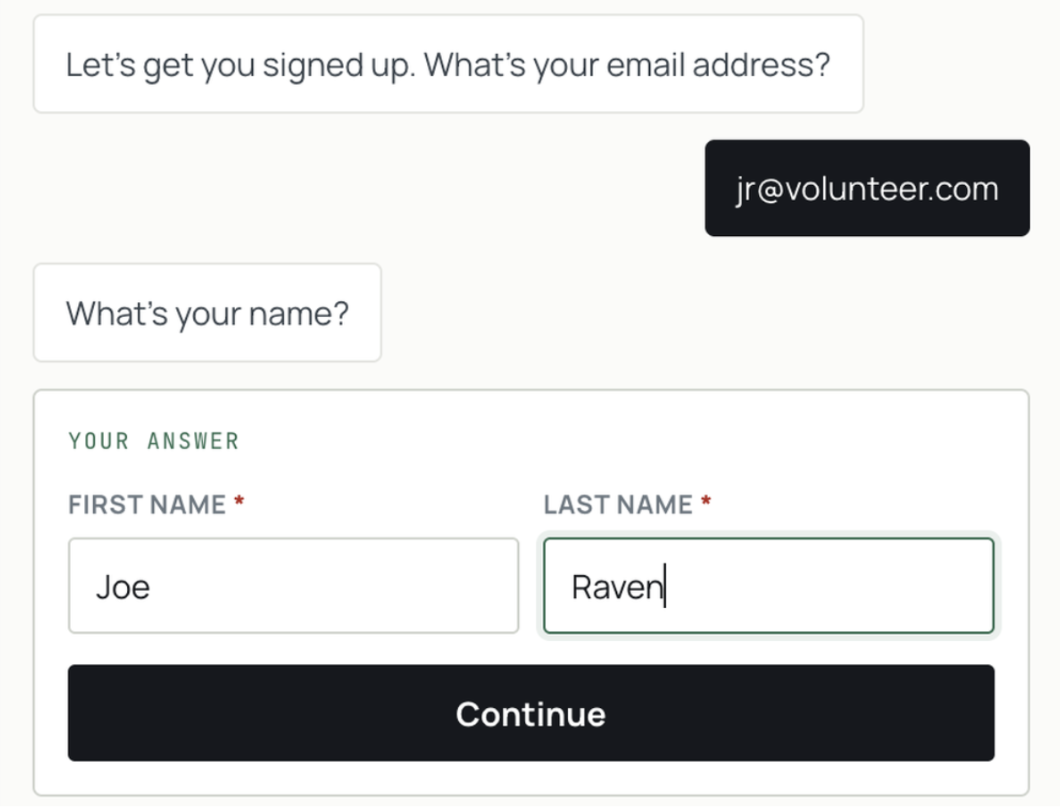
The agent asks one question, then renders the matching required fields inline.

Validation at the moment of entry

Every saved record passes through a deterministic validation tool. The model never decides on its own whether a value is valid. Emails get a format check, phone numbers are normalized to ten digits, and birth dates are tested against a minimum age.

Free text gets normalized as well. “Next Tuesday” becomes a date, and “my wife” maps to the Spouse picklist value.

When a value fails, the tool returns the specific reason and the agent asks again in context. That costs one extra message. On a traditional form the same error shows up as red text after submit, often on a field the person scrolled past minutes ago.

A bulk path for groups

Conversation is the wrong interface for entering forty people. For bulk entry the agent switches to a structured file. It generates a spreadsheet template from the same schema, with required columns marked and dropdowns built from the picklists.
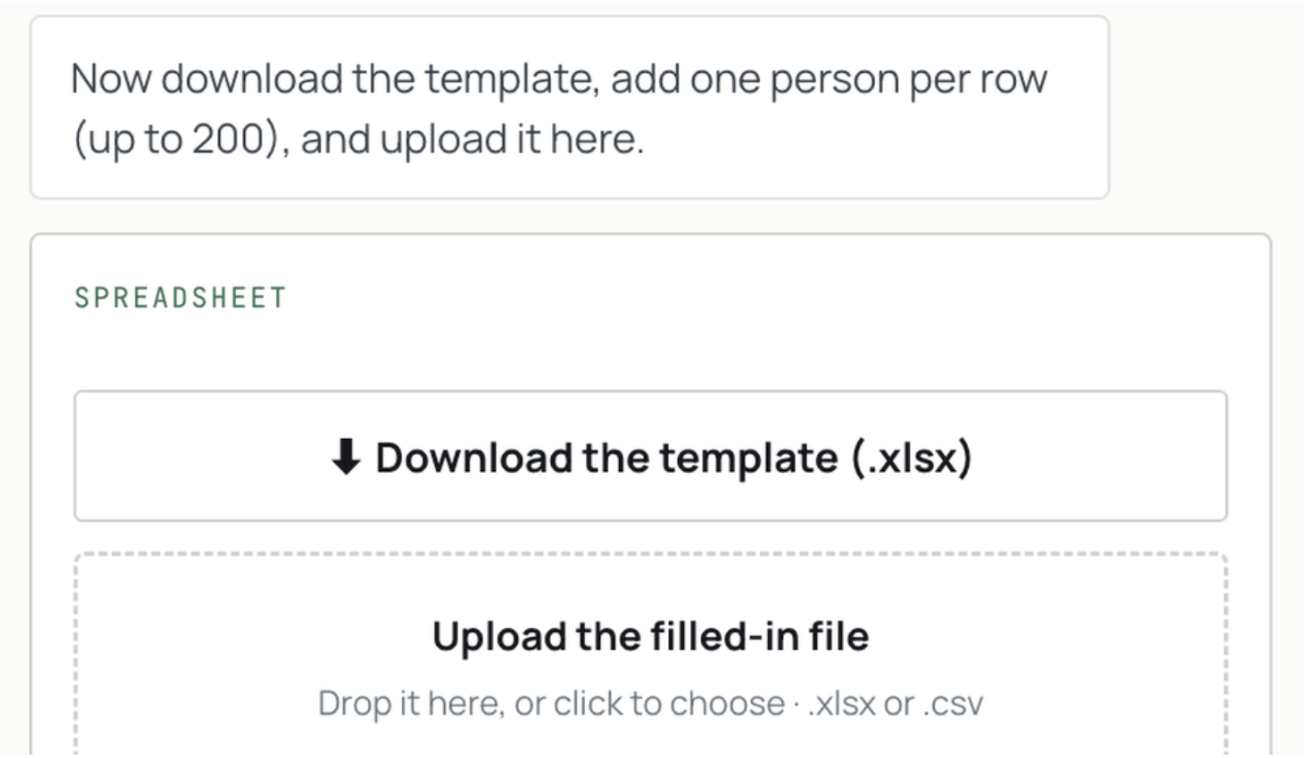
The agent hands group coordinators a schema-built template and an upload target in the same chat.

When the file comes back, each row runs through the validators the chat uses. Rows that pass are staged. Rows that fail come back as a short list with the row number and the reason, so the coordinator can fix three cells and keep the rest.

Because one schema drives both paths, a rule changed once applies to chat and spreadsheet alike.

Confirm before commit

Nothing is written until the volunteer has reviewed the whole record. The agent assembles the staged records into a review card and pairs it with any required consent, such as a waiver checkbox that must be checked before submission.

Once confirmed, the tool writes the record to the system of record in one transaction and returns the new record ID to the conversation. Your staff receives a complete, validated record and can skip the follow-up calls.
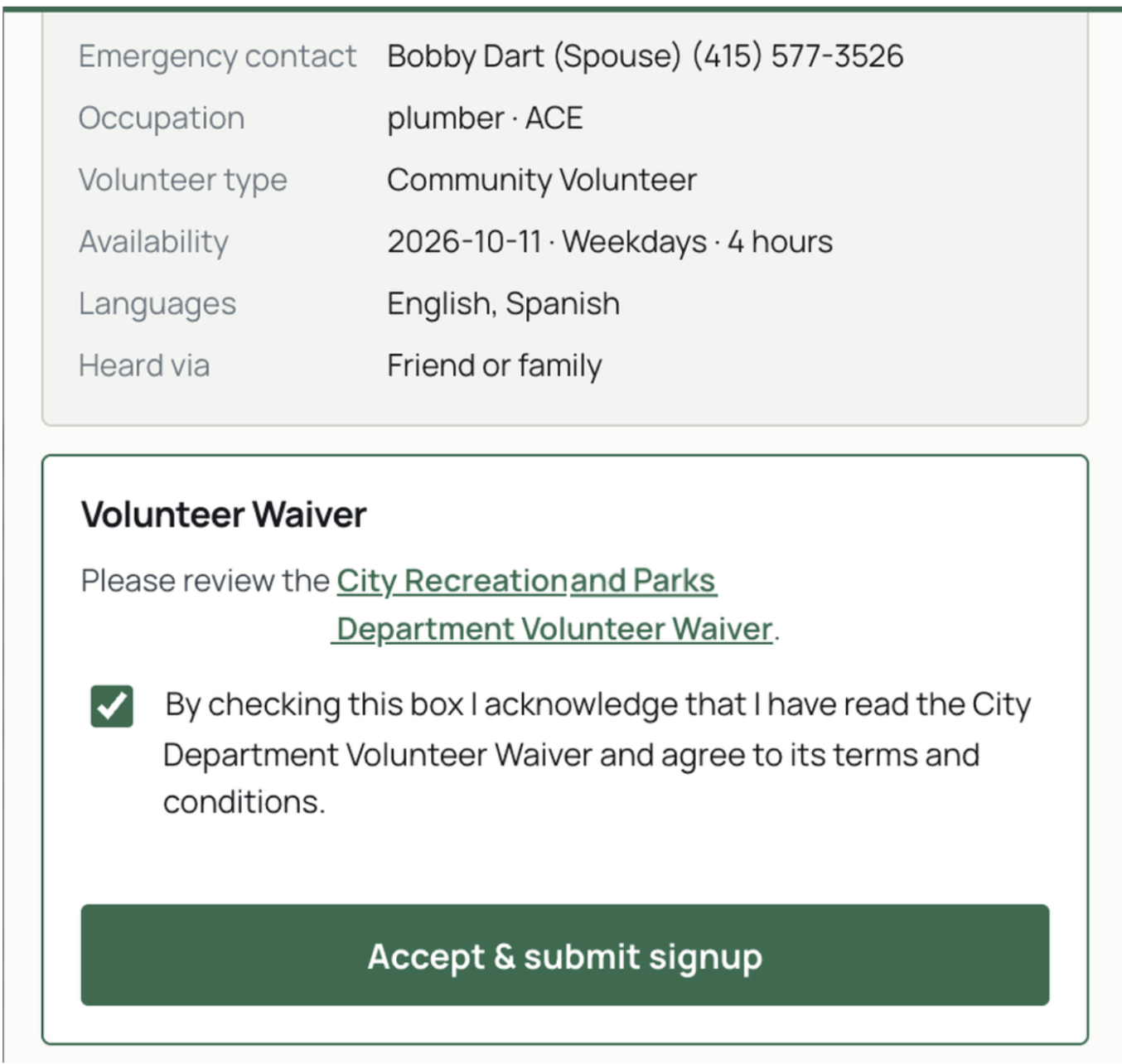
A review card of the staged values, with the waiver consent gating the submit button.

Guardrails that keep the data trustworthy

  • Narrow tools. The model never writes records directly. It calls tools with specific arguments, such as validating a field,  enforcing permissions, or saving a registration.
  • Audit trail. Every tool call is logged with its inputs, so your staff can trace any saved value back to the question that produced it.
  • Data stays home. Personal data lives in the system of record. The conversation keeps only what it needs to finish the session.
  • Clean commits. A double click or a dropped connection never creates a duplicate person.


Easier for Registrants, Better Data for You

Agents make forms better when the model handles language and deterministic code handles the data. That split lets one system serve two audiences at once. Your registrants get a better experience, and your team gets better data.

For registrants. Each step is one question in plain language, so people finish what they start. Help arrives at the field where the question comes up, with no hunting through FAQ pages. A volunteer can stop and come back without losing what they entered. A group coordinator uploads one file for forty people and fixes only the rows that need it.

For your team. Records arrive complete and checked, because every value was validated when it was entered. Staff stop chasing missing phone numbers and reformatting dates. Consent is captured with the record, so every audit has a clean trail. Each registration lands in your system the moment it is confirmed, ready for rosters and follow-up.

For the organization. The same pattern fits any intake you run today, from applications and permits to enrollments and service requests. The agent sits on top of the data model and rules you already have. You keep your system of record and change only the experience in front of it.

A good place to start is the form with the highest drop-off or the most cleanup work behind it. West Coast Consulting Group designs and builds these agents for organizations that use complex intake forms. Call (415) 626-3493 or email info@westcoastconsulting.com to talk with us about yours.
 

▶ See it on YouTube

October 23rd, 2026|Categories: AI|Tags: , , , |

Connect your Salesforce with Claude Enterprise

Your regional sales director wants to know which accounts went quiet last quarter. She asks RevOps. The report arrives four days later, after she has already made the decision. The data was in Salesforce all along. 

We natively Integrate your Salesforce Enterprise Org with Claude Enterprise 

More of our customers are asking why their sales teams cannot use AI to make sense of CRM data as easily as they use it to work through a contract or spreadsheet. Integrating Claude and Salesforce makes it possible to answer questions like these:

  • Which deals should I focus on this week based on close date, recent activity, deal size, and next steps?
  • Draft a personalized follow-up for Jane Doe based on our last meeting and the opportunity record.

Claude Enterprise pulls the relevant details from the account and opportunity records without your rep opening six tabs or waiting on a report request. Where you allow it, Claude can update Salesforce as well, following the permissions and business rules you already have in place.

Your Data and Permissions Still Matter

We handle the connection between Salesforce and Claude. We also work through the decisions that determine whether the integration produces reliable answers for your organization:

  • Which objects and fields should Claude use?
  • How should existing roles and sharing rules carry through?
  • Which records should Claude be allowed to update?
  • Which actions should require human approval?

Claude works with the Salesforce environment you have today. We review your data model so that Claude bases its answers on fields your team trusts. If account hierarchies are outdated or activity records are incomplete, we identify those issues before rollout.

Permissions require the same scrutiny. We review your current access model and tighten it where needed. Before go-live, we confirm what each role can see and what happens when Claude writes to a record.

How We Implement the integration  

We require Claude Enterprise so that access, retention, and user activity remain under your company’s administration. We integrate with Salesforce Enterprise or Unlimited Edition, which include the API access that lets us configure the integration around your permissions and processes. 

We have worked with Salesforce since 2004 and completed more than 650 cloud implementations. We know how the underlying data and access models shape the answers your users get.

We configure the connection around your existing data and access model, then test it against the questions your team actually asks and the actions you want Claude to take. If your org needs additional configuration or workflow design, we show you where and why.

Bring us the questions your sales team keeps asking. We’ll show you how Claude integrates with Salesforce in a 30-minute working session

[Request working session] https://245067415.hs-sites-na2.com/claude-salesforce-working-session

For more information, please contact West Coast Consulting Group at info@westcoastconsulting.com or call 415-626-3493.

Where AI Agents Are Delivering Real Value Today

AI agents are producing measurable returns, but mainly in well-defined workflows with clear rules and human oversight.

In an Anthropic survey of more than 500 technical leaders, 80% of organizations with deployed agents reported measurable returns. Gartner also expects more than 40% of agentic projects to be canceled by the end of 2027.

Both findings can be true. Early returns do not guarantee long-term operating value. The difference comes down to workflow design, governance, and how success is measured.

Value concentrates in work teams can verify

The strongest results appear in repetitive workflows that leave a clear record of each action. A person can quickly review the output, approve it, or handle an exception.

Coding agents have delivered some of the clearest gains. Customer service agents are resolving routine requests at scale. Security teams are using agents for alert and phishing triage, while finance and operations teams are applying them to invoice extraction, document validation, and routing.

These workflows share a practical advantage. The rules are defined, the data is accessible, and mistakes can be caught before they cause lasting harm.

Open-web autonomy and unsupervised agent chains remain far less dependable. They encounter changing websites, ambiguous instructions, credential risks, and errors that compound over time. These uses may justify controlled experiments, but they should stay away from critical operating paths.

Task length creates a reliability cliff

Short demonstrations can give a misleading impression of what agents can handle.

OSWorld 2.0 tested agents on 108 longer computer-use workflows. A skilled person needed about 1.6 hours to complete the average task. The best system completed only 20.6% of them end to end.

Performance fell as tasks grew longer. Agents completed roughly 20% to 24% of work that would take a person less than 45 minutes. Beyond 163 minutes, completion dropped to effectively zero.

The practical response is to redesign the work. If the human version takes more than an hour, divide it into shorter stages. Each stage should produce evidence someone can inspect, with approval required before the agent continues.

Today’s advantage comes from well-placed checkpoints, not from waiting for flawless autonomy.

Production value depends on more than the agent

Most buyers focus on applications, models, and orchestration platforms. The layers beneath them receive less attention, even though they determine whether an agent can operate safely in production.

An agent control plane manages identity, tool access, approvals, evaluation, and audit records. Shared protocol infrastructure connects the stack and makes it easier to change models or vendors later.
Buying an agent does not provide these controls automatically. Organizations that skip them often discover the gap after deployment, when fixing it becomes more expensive.

Model choice should increasingly become a routing decision. The workflow should remain separate from the models used to plan, execute, and review it. That separation protects the investment as model performance and pricing change.

Measure accepted results, not activity

Agent economics should be measured by the cost of an accepted result.

Compare that figure with the human cost of completing the same task, including the time spent reviewing and correcting agent output. Define what counts as an accepted result in the vendor contract.

This detail matters. Vendors may report resolution rates near 71%, while independent estimates place comparable performance between 42% and 50%. Much of the difference comes from what each provider counts as a resolution.

A change in measurement can affect the business case more than a model upgrade.

Start where proof can earn trust

The strongest first projects have clear policies, high volumes, and an existing human fallback. Leaders should be able to change the workflow directly and measure the result without relying on open-ended judgment.

Before writing prompts, define a short operating contract for the agent. State what it may do, what evidence it must produce, when it must escalate, and who owns the result.

If a workflow cannot produce evidence a person can inspect, it is not ready for production.

AI agents can create real value today. The opportunity lies in choosing work the organization can verify, governing it from the start, and expanding autonomy only after the economics and controls have been proved.

Download the full white paper, What AI Agents Actually Deliver

https://245067415.fs1.hubspotusercontent-na2.net/hubfs/245067415/What%20AI%20Agents%20Actually%20Deliver-v3.pdf


For more information on CloudCollect or our government consulting services, please contact West Coast Consulting Group at info@westcoastconsulting.com or call 415-626-3493.